Friday, 10 October 2014

Faustus Audition


Faustus Audition

As part of my audition unit and classical unit, we all had to perform a monologue out of 5 options to perform for Rachel. The Monologue that I chose was by Mephistopheles from Faustus. I decided to chose this monologue as when looking at others I was concerned at being able to pronounce Latin correctly from Choice 1 (Act 1 Scene 1). So i decided to not chose that option as i wouldn't feel comfortable and I wouldn't want that to reflect in my performance. I liked the look of option 3 of Mephistopheles as it is written in a persuasive manner and I feel I would be able  to perform that better and be able to portray that better than something that I don't feel comfortable reading and performing. 
The monologue I chose was:

MEPHISTOPHELES
Tut, 'tis no matter, man; we'll be bold with this good cheer.
And now my Faustus, that thou mayst percieve
What Rome containeth to delight thee with,
Know that this city stands upon seven hills
That underprop the groundwork of the same.
Just through the midst run flowing Tiber's stream
With winding banks that cut it in two parts,
Over the which for stately bridges lean,
That make safe passage to each part of Rome.
Upon the bridge called Ponte Angelo
Erected is a castle passing strong,
Within whose walls such store of ordnance are,
And double cannons framed of carvèd brass,
As match the days within one complete year,
Besides the gates and high pyramides
Which Julius Caesar brought from Africa.
(Faustus goes to leave)
Nay Faustus, Stay; I know you'd fain see the pope 
And take some part of holy Peter's feast,
Where thou shalt see a troop of bald-pate friars,
Whose summum bonum is a belly cheer
[MEPHISTOPHELES casts a spell.]
So, Faustus; now do what thou wilt, thou shalt not be discerned. 

Looking at this monologue, to help myself get into character and get into the true essence of the piece, I can see that the main themes to this monologue is persuasion. Mephistopheles is persuading and encouraging Faustus to go to Rome which is seen at the beginning of the monologue where Mephistopheles is telling Faustus to cheer up as Rome has a lot to offer and that there is a lot going on. Mephistopheles says 'I know you'd fain see the pope' meaning that Mephistopheles knows that Faustus would want to see the pope and is trying to persuade and encourage him to go to Rome. 

Bearing in mind all of the themes shown in this monologue it was down to me to then have this known and seen in my own performance and interpretation of the text.

In my audition I felt that I spoke with good RP and my diction and voice could be understood and was appropriate, however I am uncertain if I sounded persuasive enough and had this come through when I was speaking. I was worried about speaking the language correctly and not messing up what I was saying and going that wrong that I don't know if my performance came off too well as I was directed to look up from my script as much as possible and I am not too sure if I did that enough. I believe that if I had become more confident with what I was saying and reading that I would have been able to have included a more persuasive tone to my voice when reading the script. In that case as well being more confident with what I was reading I would then have been able to have looked up from my script more if I was more confident and knew it better. For future for when  it comes to actually audition for drama schools there would be no way that I would be able to have a piece of paper with my monologue on so I need to be absolutley certain with what I am saying and know it off by heart. This comes down to spedning  and dedication more time to learning these monolougues. For the purpose of this audition I was allowed my words but for a real audition for a drama school I would not be able to do this so learning monologus is what I need to work on and really focus on. 


Thursday, 9 October 2014

The Ancient Greek Theatre

( http://resources.mhs.vic.edu.au/creating/justice/pages/greektheatre.htm )
The Ancient Greek Theatre


The Greek theatre was built in a very large space held for spectators up to 17,000.  The Thearon Is what the area is called where the audience would be seated. The arena was in the shape of a horseshoe and the seats were tiered. This type of theatre is called and amphitheatre.  There was a circular area which was on the ground level known as the Orchestra which was where the chorus members would dance and be stood.  In the centre was the Thymele which was an altar and sacrifices were made, it was also used for props as well. To the side of the Orchestra which formed the open end to the Thearon was then the Skene which was of a wooden structure. This area was the dressing rooms for actors to get changed. The outside look to it was to try and resemble the look of a palace and was used for the purpose of a backdrop to the play.
The 3 doors to the Skene were also used for entrances and exits. The Proscenium was the levelled area in front of the skene where most of the acting and action of the play took place.
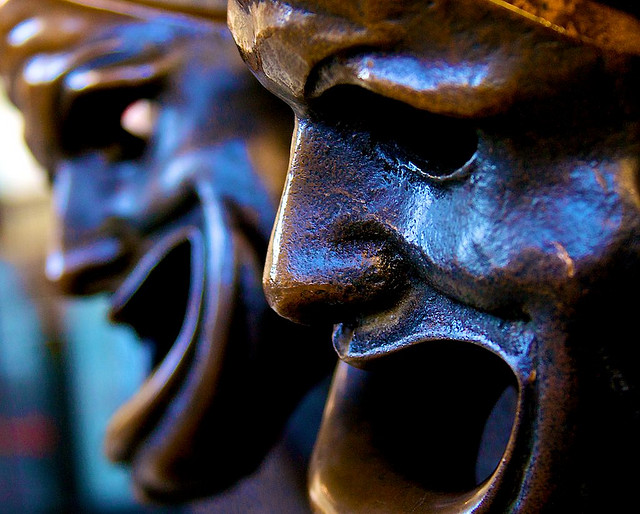
The actors performed in big costumes and masks which emphasised the characters emotions. Because they were so big this meant that people in the huge space of the auditorium would then be able to see the expression of the mask which could be seen far better from a distance rather than facial expressions. All cast members were male meaning that the masks also played a big role in creating the characters of both genders and all ages for all the male characters to perform.


The Chorus:


The chorus was a very important part of Greek, tragedy. It often consisted of 15 men whose role was to sing and dance in the orchestra as part of the tragic action that was going on in the play.
 The word choros meant ‘the act of dancing'. The dialogue between the chorus and the characters was very common in the plays and proved to be dramatically very effectively.
Tragedies were part of religious festivals and the large mass of  voices of the chorus were very appropriate for public worship. The singing was very commonly in unison, and the dancing was believed to follow the same rhythm of the songs. The tragic chorus played an important role in furthering the narration of the play and it was it could relate events that had happened prior to the action of the play, and by doing this it often placed events in a broader time span as it could also add religious or historical background to specific events that have happened during or prior to the play.

The singing of the chorus  was also a good way to give the actors time to change costumes or masks between the scenes.


Wednesday, 8 October 2014

Dr Faustus Background Information


Dr Faustus Background Information

As part of our classical unit we have started to learn about Dr Faustus by Christopher Marlowe. At the end of this first part to our classical unit we will create a studio performance of Faustus and perform short scenes in pairs to give an insight and overview to the story and plot of the play. 

Here is a some information  that I found on the plot and characters of the play to help me have a better understanding of what we are about to study and perform.
By looking at this I have learnt more about the concept of the play and the themes and ideas of selling your soul for power as I find this very interesting as this isn't something you would hear in a normal play and is a very out going theme. I would like to play Faustus as we are able to not look at type casting and  gender casting so playing Faustus would be an interesting and different character to play as he has such eccentric and abstract character and I have never played a character like that before.


Plot Overview  
Sparknotes: Dr Faustus Plot Overview [Online] Available from: http://www.sparknotes.com/lit/doctorfaustus/summary.html  [Accessed: 08/10/14]  


Doctor Faustus, a German scholar, grows unsatisfied with the limitation of his knowledge—logic, medicine, law, and religion—he decides that he wants to learn the practice of magic. His friends Valdes and Cornelius teach him in the black arts, and he starts his new career as a magician by summoning Mephastophilis, a devil. Even though Mephastophilis warned Faustus about the horrors of hell, Faustus tells the devil to return to his master, Lucifer, with an offer of Faustus’s soul in exchange for twenty-four years of service from Mephastophilis. During this time Wagner, Faustus’s servant, has achieved a magical ability and presses a clown named Robin into his service.


Armed with his new powers and assisted by Mephastophilis, Faustus begins to travel. He goes to the pope’s court in Rome, makes himself invisible, and plays a series of tricks. He disrupts the pope’s banquet by stealing food and causing havoc. Further to this he travels through the courts of Europe, with his fame spreading wherever he goes. Eventually, he is invited to the court of the German emperor, Charles V (the enemy of the pope), who asks Faustus to allow him to see Alexander the Great, the famed fourth-century B.C. Macedonian king and conqueror. Faustus conjures up an image of Alexander, and Charles is very impressed. A knight laughs at Faustus’s powers, and Faustus punishes him by his mocking making antlers form out of his head. the knight vows revenge furious by Faustus' actions.
As the twenty-four years of his deal with Lucifer come to a close, Faustus begins to dread his approaching death. He has Mephastophilis call up Helen of Troy, the famous beauty from the ancient world and uses her presence to impress a group of scholars. An old man encourages Faustus to repent, but Faustus drives him away. Faustus summons Helen again and raves about her beauty. Faustus tells the scholars about his pact, and they are horror-stricken and resolve to pray for him. On the final night before the expiration of the twenty-four years, Faustus is overcome by fear and remorse. He begs for mercy, but it is too late. At midnight, a host of devils appears and carries his soul off to hell. In the morning, the scholars find Faustus’s limbs and decide to hold a funeral for him.

List of all characters in the play  
Sparknotes. Dr Faustus Character list. [Online] Available from: http://www.sparknotes.com/lit/doctorfaustus/characters.html [Accessed: 08/10/14]
Faustus  -  Faustus is a brilliant sixteenth-century scholar whose ambition for knowledge, wealth, and worldly might makes him willing to pay the price of his soul to Lucifer in exchange for supernatural powers. Faustus is seen by that he never seems completely sure of the decision to forfeit his soul and constantly wavers about whether or not to repent. His ambition is admirable and initially all well and good, yet he ultimately lacks an inner strength. He is unable to embrace his dark path wholeheartedly but is also unwilling to admit his mistake.

Costume lesson 29/09/14


Costume lesson 29/09/14

In today's lesson was the start of creating our hat for our mini costume design unit. I provided the 3 different coloured tape that we needed and Catrina brought newspaper, glue gun, cardboard and a balloon. 
We decided as a group for all of us to be allocated to a different role in the making process of the helmet so, John and Grace were in charge of making the horns and Catrina and I were in charge of making the hat its self. We started by measuring a piece of tape that would be used as a guide to a headband and was sized to Josh's head - as he was the model for our hat - and then folded the tape in half so that it was around an inch wide but was not sticky as the sticky sides were folded together. The next step was to blow the balloon up inside the headband to make a nice tight fit and the headband stable around the blown up balloon. the next step was to cover the top area of the balloon with tape which proved a little difficult on your own as the balloon kept on moving around so Catrina and I helped each other by holding the balloon for each other to put the tape on. Once this was completed we got onto the stage of hot glue gunning triangular pieces of cardboard onto the top half of the balloon which is to be the helmet to create a strong structure and hold for the helmet. Catrina and I only got up to this stage today by finishing the cardboard stage and will be able to finish the rest of the helmet next week for when we present it to the rest of the class. Grace and John did well as they created a strong horn shapes out of newspaper and were able to start part of the covering of it with the yellow coloured tape. 

This is the stage that we got up to in today's lesson:


I feel today was a good start to making our helmet and I feel we all worked well and were focused on making our product. I believe we are meeting our brief's criteria and I believe it is a suitable product and the material and look is suitable because the materials that we have used are not harmful to children as we are designing a product for children's theatre. We are also using appropriate colours for our helmet as originally we discussed using red tape for red horn but then we decided against that as our character is the hero of the story and red can sometimes be associated with evil and that would the wrong imagine that we are trying to portray for our character. We then decided on doing yellow/gold instead as they are more regal colours and our character is an important leader and also they are happy and bright colours which will reinforce our idea and design that our character is a hero to the story. 

Next week will will continue making our product and be able to finish it to present to the class and be able to explain our design and choices of colours and materials and appropriateness to the task and be able to have josh model our hat. 

Tuesday, 7 October 2014

An Introduction to Greek Theatre


An introduction to Greek Theatre

  • Greek tragedy looks at suffering and pain
  • their themes are so universal and are so relateable to today day and age and people still suffer
  • Aristotle - 4th Century Greek Philosopher - Came up with a formula- the hero's of tragedy needed to be good but not so good that you couldn't relate to them
  • Harmatia- the error of judgement is actually about real people making bad decisions and mistakes often for good reasons
  • Greek tragedy is about that we live in a flawed world full of suffering, injustice and misery. But it also shows that these things happen from our actions
  • Almost all the plays sees someone die during the play
  • Many characters are usually dressed as the sun or in representational colours and is used as a metaphor 
  • Greek theatre is a stylised genre
  • It has a fairly fixed structure: starts with prologue setting the scene and then chorus come on and sing
  • The plot to these plays are innovative and are made for everything to happen in the play in less that the time between a sunrise and a sunset. Clear skillful writing 
  • Aristotle talks about Catharsis which is cleansing/purity
  • After watching a tragedy you feel pity and fear and almost cleansed in a sense- it is emotionally draining as it's traumatic but also a good feeling
  • Tragedy is about confronting suffering and death, mourning and loss- it enables us to find reflections in our own lives and see that the feelings and ideas are shared
  • The first plays in the world were held in Amphitheatres all around Greece 
  • Greek Theatre started between 525 & 550 BC
  • Theatres were in a semi circle
  • Greek theatre looks at mythical heroes 
Actors of Greek theatre 

  • Division between actors and chorus
  • There are very few actors and it is a very professional activity
  • Actors would change masks and costumes and body language to play characters
  • Started off with 3 actors as it was a high professional skill
  • Actors had to be prepared to play both men and women, old and young
  • Chorus members are not professional actors but are ordinary villagers of the town
  • Athens was alive with song and dance in the beginning time of Greek Theatre
  • Vases from the Greek perios give us some ideas from their paintings of costume and choreography of that time
  • Tragedy and Comedy Masks became a big part of the theatre
  • They wore masks to be properly visable - improvisation
  • Masks gives the skills to deliver characters and improvisation
  • All of the actors were originally men
  • The actors didn't wear makeup but they used hand held masks so they could show more emotions and so they could act as women
  • There were around 1000 actors in one play
  • A theatre could hold up to 18000 spectators
http://www.brunswick.k12.me.us/hdwyer/files/2012/08/3216862621_5e7d361ab3_z.jpg
[Accessed: 07/10/14]


Monday, 6 October 2014

Electra - Characters, Plot, Themes

gradesaver. Electra by Sophocles. [Online] Accessed from: http://www.gradesaver.com/electra-by-sophocles/study-guide/character-list/ [Accessed: 06/10/14]


comments in pink are my notes and opinions from the research that I have found
Highlighted yellow are notes important to my character


Characters


Electra -
Electra is the daughter of Agamemnon and Clytemnestra, and the title character of the play. She is furiously angry and bitter about the way her mother has murdered her father and partnered with Aegisthus. She refuses to cease mourning, and is prone to huge, bellowing cries of grief and rage. She is desperate for her brother Orestes to return. Significantly, she trusts nothing and no one, and believes in deeds rather than words - which is perhaps why her own language is so painfully raw and stripped back.

She is the central character of Sophocles' treatment of this story, though interestingly, not of the story itself. The other characters in the play however seem to pale into insignificance when compared with her: for sheer force of will, and force of hatred. In our version of the play we are going to be having 3 Electra's so that they can show the different emotions that she feels. The first Electra will be angry and hold the most anger towards her mother Clytemnestra, Electra 2 is feeling lost and distraught over her brother's death and Electra 3 is at the tipping point and all her feelings are built up and she is at breaking point and Orestes then ends up killing their mother

Agamemnon - Deceased Father
Agamemnon was the husband of Clytemnestra, and the father of Electra and Orestes. He was murdered by Clytemnestra before the play began, and the play documents Orestes' vengeance on his mother for that act. He does not appear in Sophocles' Electra directly, but is still in many ways a key character. Agamemnon is only referred to throughout the play as he is dead - killed by Clytemnestra. He is key to Electra's anger towards Clytemnestra as Electra believed she only killed Agamemnon for the fact he found out about her affair.

Paedagogus - Teacher
A pedagogue - a tutor - as suggested by his name, now old, who looked after Orestes when he was younger. 

He narrates the false story of Orestes' death in a chariot race, and, as he and Orestes plan early in the play, no-one recognises him as he now has grey hair. Paedagogus has several key moments, that push the plot out of words and towards action. The character's name will be the Old Man in our play and he has brought Orestes up throughout his life and has been teaching him throughout his life to learn about what it means to avenge the person who killed their father.

Orestes - Vengeful Brother
The son of Agamemnon and Clytemnestra, and the brother of Electra and Chrysothemis. Orestes, in other retellings of this same story, is undoubtedly the principal character: certainly in Homer, and also in the Oresteia (a trilogy which, notably, bears his name!). Not so in this play. Electra is very much central to Sophocles' conception of this play, though Orestes is still important.
Moreover, Orestes is important largely because he does not seem the hero we might expect from other versions of the same story. This is an Orestes who is more than prepared to use false words, so long as they get the right outcome: the means, in other words, are absolutely justified by the end. David Grene describes him as "cautious and rather colourless".
Orestes returns to the House of Atreus to revenge his father's murder by killing his mother, and, at the end of this play, kills Clytemnestra and is about to kill her lover, Aegisthus.

Chorus
A group of women of Mycenae, who look onto events, and attempt to advise Electra. The most unusual choral moment in the play comes when Electra interrupts their ode (of only twelve lines) by coming out of the palace, and back onstage to commentate on Orestes' murdering Clytemnestra. We are going to have 4 Chorus members who are going to act as part of Electra's mind and feelings.

Clytemnestra - Mother/Murderer/Wife of Agamemnon then Aegisthus
Clytemnestra is not merely a savage, terrifying woman but one that has a visible human streak. Clytemnestra suffers from nightmares and, when she appears and justifies her killing of Agamemnon (by recourse to the Iphigenia story) she seems somewhat more reasonable than Electra!

Clytemnestra has a central argument in the middle of the play with Electra, whose fury knows no bounds towards her, before she is eventually murdered in her palace by Orestes. When it comes to doing my performance I am going to really show my hate towards Electra as it is her fault that Orestes was taken away. I am a very stern character and have a lot of anger but a lot of it is at Electra's father - who I killed and I want it to be known that I killed him out of revenge of him killing my daughter and not for any other reason.  I want to portray her with a really split personality and holds loads of anger to Electra and then trys to win over the Old man to convince him how upset I am over the death of Orestes.


Chrysothemis -Living sister of Electra/Orestes
Sister of Electra and Orestes, daughter of Agamemnon and Clytemnestra. Chrysothemis' role is a similar one to Ismene in Antigone: she advises Electra to be cautious, not to make things worse unnecessarily, and to try and keep her feelings under wraps.

Chrysothemis says at one point in the play that she feels as angry and upset as Electra does - only she doesn't go around making it quite so clear because she wants life to be as bearable as possible. She is, in the apt words of David Grene, 'timid, sensible, and unattractive', and she has disappeared from the play by the time the murder takes place. Through casting we are using 2 sisters and splitting the lines of the one sister between two

Aegisthus - 2nd husband of Clytemnestra
2nd Husband of Clytemnestra, and a descendant of the House of Atreus. 

Aegisthus only makes one appearance in this play, late towards the end, where Sophocles establishes him as a bully and a self-regarding tyrant. He taunts and mocks Orestes even when he is about to die, and before that, spends most of his time handing out brisk orders to anyone who will listen. He is not a major character in the play, but important to anyone looking closely at the circumstances which have created Electra


Plot 
English Literary Society. 29 July 2011 by Aajiz. Electra Study Guide and Summary. [Online] Accessed from: http://www.eliterarysociety.com/tag/delphic-oracle/ [Accessed: 06/10/14]


Electra Plot Summary
 
Before the play begins Clytemnestra murders her husband and Father of her children, Agamemnon.

At the start of the play The Old Man (Orestes’ old tutor) has returned to the royal palace in Mycenae, to avenge the murder of Agamemnon. 

Orestes tells the old man that the Delphic oracle has told him how he should be revenged on those who murdered his father. He instructs The Old Man to falsely report his death so that Orestes and Pylades can visit Agamemnon’s grave and return to the palace with an urn (which they will say contains Orestes’ remains) The plan means that no one will be expecting a strike against Clytemnestra and Aegisthus. 

A cry is heard from inside the house, and Orestes and The Old Man exit. 

Electra enters, making a long prayer to “Holy Light”. She is in constant mourning for her father’s death, hardly sleeps, dresses in unsightly and poor clothes, and refuses to stop calling on the gods to bring vengeance. 

The Chorus argue that she should mourn within normal limits, and no more, and Electra rejects their argument. She longs for Orestes to return to avenge her father’s death. It is impossible for her to behave moderately, she says, when she is surrounded by evil.

Chrysothemis, (Electra’s sister) enters with burial offerings. She asks Electra why she is still shouting publicly about her father and her longing for vengeance. Then, Chrysothemis continues, she herself would be openly angry if she had strength. She, however, chooses to be deliberately silent – a decision which Electra then scorns. Chrysothemis argues that Electra’s fury will be the undoing of her, only for Electra to reply that she would welcome death.

Chrysothemis is taking burial offerings from her mother to Agamemnon’s grave. Clytemnestra has sent the offerings after being frightened by a dream in which she saw Agamemnon revived. Electra persuades Chrysothemis not to take Clytemnestra’s offerings to the grave.

The Chorus predict Justice coming and “foreshadowing a just victory”. 

Clytemnestra enters, surprised to see Electra walking outside, and an argument ensures between mother and daughter. Clytemnestra says that she was justified in murdering her husband, as he sacrificed her daughter Iphigenia. 

Electra then launches into a long speech, which tells another version of Iphigenia’s sacrifice, and interrogates the “eye for an eye” logic that Clytemnestra puts forward. This rant becomes increasingly more personal, with Electra even eventually telling Clytemnestra that she would have Orestes kill her if she could. 

Clytemnestra, left alone, makes a prayer to the gods, hoping that all will be well for her.

The Old Man, disguised as a messenger, comes in and tells a long story about Orestes’ supposed death. Electra is devastated, and Clytemnestra torn between being delighted and mournful. Clytemnestra goes into the house with The Old Man.  

Electra resolves to bring about her own death: without Orestes, she has nothing to live for.The Chorus try to comfort her. 

Chrysothemis enters, having found Orestes’ hair on Agamemnon’s grave, to tell Electra that Orestes has come to the palace. Electra tries and fails to persuade Chrysothemis to help her murder Aegisthus. Electra resolves to do the deed alone.

Orestes enters disguised, and reveals himself to Electra, proving with Agamemnon’s signet ring that he is indeed Orestes. He then goes inside to murder Clytemnestra, and Electra goes inside the house. 

The Chorus begin an ode, which is interrupted by Electra running back outside. 

Clytemnestra is heard screaming from inside the palace, and Electra shouts encouragement to Orestes from outside.
Orestes enters from the palace, and Electra asks him if all is well. Orestes replies that all is well, if Apollo prophesied well. 

Aegisthus approaches, Orestes goes inside, and Electra greets Aegisthus. Bringing on a covered body (Orestes in disguise again), they tell Aegisthus it is the dead Orestes, though when it is uncovered, it is in fact the murdered Clytemnestra. Aegisthus is taken inside the palace to be murdered by Orestes, and – before we see or hear the deed.

The Chorus end the play.

I have a much better understanding of the play as I understand the plots and how each character is involved with the other. I am looking forward to playing Clytemnestra as she is such a powerful and dominating woman that I have never played a character like this before. I feel that this character will help me in my classical acting and help me also understand Greek Theatre.


Themes

Justice
Justice is a word closely related to "judgment" and "judge", and a key question of the play is "who has the right to judge?" 

Many characters, Clytemnestra, Orestes, and Electra among them claim that they are acting in the interests of justice. In the end though, with no trial and no divine intervention, Sophocles finally leaves the question of justice with his audience.


Cause and effect


 The death of Iphigenia  (Clytemnestra's Daughter) leads to the death of Agamemnon, which leads to the death of Clytemnestra; as the play ends, it seems the death of Aegisthus will follow. Electra herself has often been read as the product of her unhappy circumstances: someone turned bitter and angry as the result of a horrible situation. It is an interesting theme to trace through the play, examining how one thing happens in a domino effect

Revenge
Electra is deeply concerned with the idea of vengeance, particularly with an examination of "eye for an eye" logic.

One murder leads to another, and, by locating the Aegisthus murder just outside of his play, Sophocles creates the impression that the line of deaths might stretch out forever.


Gender
Throughout the play, Sophocles explores the idea of Electra as a woman with a man's heart and a man's fury: like her mother before her, she refuses to behave in the way society expects a woman to behave. So
phocles explores our expectation of men and women, and interrogates the nature of both roles. 

These themes have made me have a better understanding of justice and how my character Clytemnestra acts in the way she did as an act of Justice and it was the right thing to do.
Revenge is also seen because I act in an act of revenge to kill my husband for killing my daughter however Electra sees it as an eye for an eye and that I should be killed for killing my husband. I can now portray this all into my character now that I have a better understanding of the themes


Sunday, 5 October 2014

Letter 1

Job title: Front of House Senior

Dear Employer,

Following your advertisement for the job of Front of house senior seen online, I am writing to you in hope for an interview for this position, my credentials are as follows.
I am a highly experienced performer in all three disciplines - singing, dancing, acting - the skills that I posses from this training and experience are high levels of people and socials skills and the ability to interact with new and different people. I am a team player and able to communicate ideas to a group and able to listen to others views opinions and ideas. I have been dancing at a dance school from the age of 2 and a half and have been trained in a disciplined way meaning that I have strong listening skills and able to take criticism and direction from people and able to apply this to my work and performance. I have experience doing front of house work at local theatre companies that I am involved with near to where I live in West Sussex where I took on roles of selling programmes, selling tickets on the door at the box office and ushering audience members to their seats. 
I have had a part time job working at a hairdressers as a shampooist, receptionist and assistant to the top stylist of the salon. The involvements of the job role was working with the public and clients and interacting and having a high level of social skills with clients. I also dealt with money and reception work along side sorting out staff's wages and weekly and monthly takings of the salon. I feel I would be able to bring my experience and confidence to this job position and be able to meet your requirements as I have experience in work in box office and front of house operations. I believe that through all the experience I have had in both performance and employed work I would be suitable for the job through my training in performance and the skills I have gained  as I would be confident with speaking publicly and working with the general public and be comfortable in social situations. I have done reception work and selling tickets in a box office meaning I have had experience in admin and handling money and finance matters. I feel I am qualified enough for this job and feel I would bring a good energy to your team and be able to meet your high standard of work.
I hope to hear from you soon regarding this job placement 
Thank you for your time

Regards,


Sophie Shepherd